If you are applying for the Lifeline program based on income, you may be asked to provide documents that prove how much your household earns. Knowing which documents count can help you avoid delays, rejected documents, or requests for more information.
For 2026, Lifeline income eligibility generally requires your gross household income to be at or below 135% of the Federal Poverty Guidelines. For a household of one in the 48 contiguous states, D.C., and territories, that limit is $21,546. The limit increases with household size and is different in Alaska and Hawaii.
The good news is that you do not always need a single document. Lifeline accepts several types of official income records.
Read More: Apply for Lifeline Application Online 2026
What Is Prove Your Income for Lifeline?
Proof of income is an official document showing how much money you or your household earns.
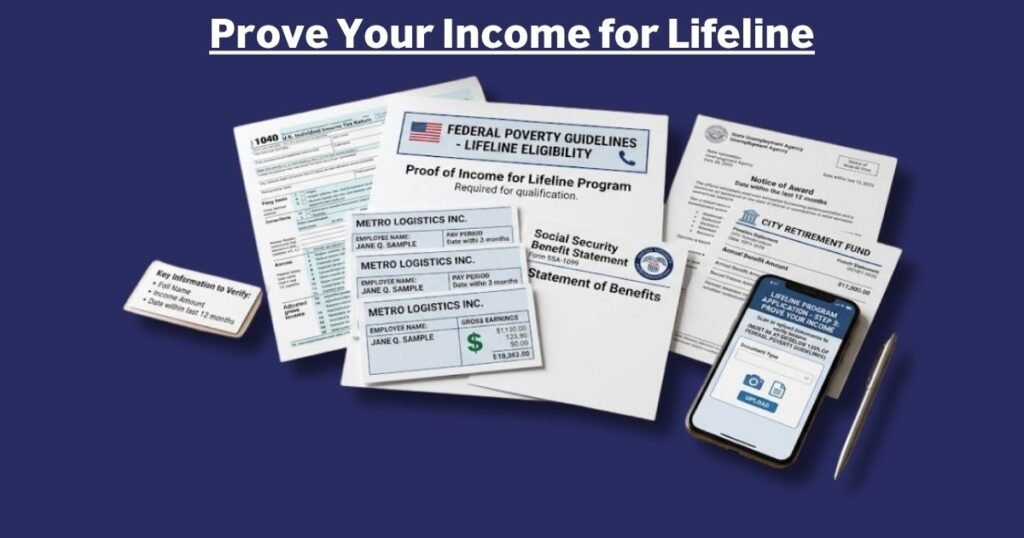
When you apply through the income route, your document generally needs to show:
- Your name or your dependent’s name
- Your annual income
- An issue date within the last 12 months
USAC, which administers Lifeline for the FCC, lists several documents that can be used to verify income.
Read More: Lifeline Free Phone And Tablet Combo Program
Documents You Can Use to Prove Income
Here are some of the most common forms of Lifeline income verification.
1. Federal, State, or Tribal Tax Return
A prior-year tax return is one of the clearest ways to prove your income.
Your tax return should show your name and the income information needed to determine whether your household meets the Lifeline income requirement.
USAC specifically lists a prior year’s federal, state, or Tribal tax return as acceptable income documentation.
2. Pay Stubs
If you work for an employer, your paycheck stubs may be used as proof of income.
If your income document does not cover a full year, USAC says you generally need the same type of documentation covering three consecutive months within the previous 12 months.
For example, you could provide pay stubs for:
- January
- February
- March
The important point is that the months should be consecutive.
3. Employer Income Statement
An employer may provide an official statement showing your current annual income.
This can be useful if your employer does not provide traditional pay stubs or if your annual income information is easier to document through an employer statement.
USAC lists a current employer income statement among acceptable income documents.
4. Social Security Benefit Statement
If Social Security benefits are part of your household income, a Social Security statement of benefits may be used.
USAC also lists Veterans Affairs, retirement or pension, unemployment, and workers’ compensation benefit statements among acceptable income documentation.
5. Child Support or Divorce Documents
Some households receive income through child support or other court-ordered payments.
A divorce decree, child support award, or other official document containing income information may be accepted for Lifeline income verification.
6. Unemployment or Workers’ Compensation Statement
If you currently receive unemployment or workers’ compensation benefits, an official benefit statement can help document your income.
Make sure the document contains the information needed to identify you and establish the amount of income.
How Much Income Can You Have for Lifeline in 2026?
For the 48 contiguous states, Washington, D.C., and U.S. territories, the 2026 Lifeline income limits are:
| Household Size | Maximum Annual Income |
|---|---|
| 1 | $21,546 |
| 2 | $29,214 |
| 3 | $36,882 |
| 4 | $44,550 |
| 5 | $52,218 |
| 6 | $59,886 |
| 7 | $67,554 |
| 8 | $75,222 |
For each additional household member after eight, the limit increases by $7,668. Alaska and Hawaii have higher limits.
These figures represent 135% of the 2026 Federal Poverty Guidelines.
What If You Do Not Have Pay Stubs?
Not having traditional pay stubs does not automatically mean you cannot prove your income.
You may have another acceptable document, such as:
- A previous-year tax return
- An employer income statement
- Social Security statement
- Pension or retirement statement
- Veterans benefit statement
- Unemployment benefit statement
- Workers’ compensation statement
- Child support or divorce documentation
- Another official document showing your income
USAC’s current documentation rules are the best reference because individual situations can vary.
If you are self-employed or have irregular income, be especially careful about submitting documents that clearly establish your annual household income. Do not assume that every bank statement, handwritten income record, or screenshot will automatically satisfy Lifeline’s documentation requirements.
Can Bank Statements Be Used as Proof of Income?
This is a common question.
Bank statements are not listed by USAC’s current standard income-document list as one of the main examples of proof of income. The official list focuses on tax returns, employer income statements, pay stubs, benefit statements, and other official income documents.
Therefore, if you have a tax return, pay stubs, or another listed document, it is generally better to use the documentation specifically identified by Lifeline.
If USAC asks you for additional documentation, follow the instructions in your application or notice.
What If Your Income Changes Every Month?
This can make Lifeline income verification confusing.
For example, imagine you work seasonal jobs:
- January: $1,200
- February: $1,400
- March: $1,300
- April: $2,500
Your income may not be the same every month.
If you use pay stubs or another income document that does not cover a full year, USAC says the documentation should cover three consecutive months within the previous 12 months.
Do not simply choose random months because they show your lowest income.
What If You Qualify Through SNAP or Medicaid?
You may not need to prove your income if you qualify through a Lifeline-qualifying government assistance program.
Lifeline allows consumers to qualify through income or through participation in a qualifying program. Examples include:
- SNAP
- Medicaid
- Supplemental Security Income (SSI)
- Federal Public Housing Assistance
- Veterans Pension or Survivors Benefit
If you qualify through a program, you generally need documentation showing your name, the qualifying program, the issuing government or administrator, and the required date information.
This can be an easier route for someone who already receives qualifying benefits.
Common Lifeline Income Proof Mistakes
Your application can be delayed if your documents do not provide the information needed for verification.
Mistake 1: Sending an old document
Check the date before uploading anything. USAC’s income documentation requirements include an issue date within the previous 12 months for the listed documents.
Mistake 2: Sending only one pay stub
One recent paycheck may not be enough when your documentation does not cover a full year.
USAC says the same type of income documentation should cover three consecutive months in these cases.
Mistake 3: Uploading a blurry photo
Your document should be readable. Make sure the complete page is visible and that important information is not cut off.
Mistake 4: Using documents belonging to another person
The documentation should connect your income to you, your dependent, or the relevant household circumstances.
Mistake 5: Reporting the wrong household income
Lifeline looks at household income, not simply the income deposited into your personal bank account.
If you are unsure who counts as part of your Lifeline household, review the official household rules before applying.
What If Lifeline Rejects Your Income Proof?
Don’t immediately submit the same document again.
First, read the message from the National Verifier or Lifeline Support Center. It should tell you what information is missing or what type of documentation is needed.
USAC’s application-error guidance provides specific documentation requirements for income verification and other common verification problems.
Before uploading again, check:
- Is your name visible?
- Is your income amount visible?
- Is the document recent enough?
- Does it cover the required period?
- Is the entire document readable?
- Are you using an official document?
Fixing the problem before resubmitting can save time.
Lifeline Income Proof Checklist
Before submitting your documents, use this quick checklist:
☐ Your name is clearly visible
☐ Your income information is visible
☐ The document is official
☐ The document meets the required date rules
☐ Pay stubs cover three consecutive months when required
☐ The image or PDF is clear
☐ No important information is cut off
☐ Your reported household information matches your application
Keyword Gap and Information Gap Analysis
Many competing Lifeline articles focus on basic eligibility and simply list documents. A stronger article can target the questions people ask after they start the application.
Keyword opportunities
Consider targeting related phrases such as:
- how to prove income for Lifeline
- Lifeline proof of income
- Lifeline income verification
- documents needed for Lifeline
- Lifeline income proof documents
- what counts as proof of income for Lifeline
- Lifeline pay stubs
- Lifeline tax return
- Lifeline income verification documents
- three months pay stubs Lifeline
- Lifeline income limit 2026
- Lifeline application income verification
- how to verify income for Lifeline
- Lifeline proof of income self employed
- Lifeline income documentation requirements
Information gaps competitors often miss
A useful content strategy is to explain the practical problems applicants encounter:
- Why three consecutive months of pay stubs may be required
- What information must appear on an income document
- What to do when income changes from month to month
- What happens when an income document is too old
- Difference between qualifying by income and qualifying through SNAP or Medicaid
- What to check when income verification fails
- How self-employed or irregular-income applicants can approach documentation
- How household size affects the income limit
These topics match the questions people are likely to have after seeing the basic eligibility requirements.
FAQs About Proving Your Income for Lifeline
What is income verification for Lifeline?
Income verification is the process of confirming that your household meets the Lifeline program’s income eligibility requirements. You may be asked to provide documents showing your current household income.
What documents can I use to prove my income?
Depending on your situation, acceptable documents may include recent pay stubs, a tax return, an official statement of benefits, an employer statement, or other documents that show your income.
How many income documents do I need?
The number of documents required can vary depending on your application and the verification process. Follow the instructions provided in your Lifeline application or verification notice.
Can I qualify for Lifeline based on my income?
Yes. Lifeline eligibility can be based on household income or participation in certain qualifying government assistance programs. Income must generally fall within the program’s applicable eligibility guidelines.
What if I have no income?
If you currently have no income, you may still be eligible for Lifeline through income-based eligibility or participation in a qualifying assistance program. You may need to provide documentation explaining your circumstances.
Can I use a tax return as proof of income?
A tax return may be accepted as income documentation in some circumstances. Make sure the document is current and meets the requirements specified in your verification instructions.
What happens if I cannot provide the requested documents?
If you cannot provide the requested documentation, carefully review your verification notice for alternative documents or instructions. Contact the appropriate Lifeline support or administrator if you need clarification.
Does everyone in my household need to provide income documents?
Not necessarily. Household-income eligibility is based on the program’s definition of a household and its verification requirements. You should provide the documentation requested for your particular application.
How often do I need to verify my Lifeline eligibility?
Lifeline subscribers generally have ongoing eligibility requirements and may be asked to recertify. The exact timing and process can depend on your circumstances and the instructions you receive.
Where can I get help with Lifeline income verification?
For the most accurate and current requirements, use the official Lifeline program resources or contact the Lifeline support service identified in your application or verification notice.
Final Thoughts
Proving your income for Lifeline does not have to be complicated. Start with an official document that clearly identifies you and shows your income.
A prior-year tax return, current employer income statement, qualifying benefit statement, or three consecutive months of the same type of income documentation may be used depending on your situation.
If you already receive SNAP, Medicaid, SSI, or another qualifying program benefit, check whether you can apply through program participation instead of income.